
Norwalk County Court Records After a Jail Arrest
An arrest does not create a court record on its own. Norwalk Police process the person first. They post the event on the city daily arrest log. The court record begins later. A prosecutor from the Office of the State's Attorney reviews the arrest. The prosecutor then decides what to file. Those filed charges open a case at Norwalk Superior Court Geographical Area No. 20. That is the local criminal court. From that point the case is the live court record, not the arrest. Connecticut has no county sheriff jail. It has no county district attorney either. So the path runs from city police to a state court and a state prosecutor.
The booking side and the court side answer different questions. The booking event, the arrest time, and the case number come from the city log. The Norwalk Police records unit is the backup for that detail. The jail inmate records page walks through custody lookups. Booking photos sit on the jail mugshots page. The court record is a separate thing. It holds the charges the prosecutor actually filed. It also holds the bond, the court dates, and the final result. After a Norwalk arrest, both records can exist at once. They can say slightly different things.
From a Norwalk Arrest to GA 20 Court
The route from street to court file is short. It still has clear steps. Each step is run by a different office. That is why the records live in different places. The flow runs in order. Arrest by Norwalk Police comes first. Then the 6 a.m. daily arrest log. Then arraignment at GA 20. Then the prosecutor files or amends the charges. Then the court record opens and updates as the case moves.
- Norwalk Police make the arrest and process the person at headquarters on Monroe Street.
- The arrest appears on the city running arrest log, which is built automatically each morning at 6 a.m.
- The person is given a court date for Norwalk Superior Court GA 20 at 17 Belden Avenue.
- At arraignment a prosecutor reviews the arrest and files, amends, or declines the charges.
- The court record opens under the case number and tracks bond, dates, and the final outcome.
Norwalk GA 20 serves five towns. They are Norwalk, New Canaan, Weston, Westport, and Wilton. A person arrested in any of them is likely to be arraigned there. The court splits work by how serious the charge is. The Judicial Branch processes major felonies at Judicial District locations. Other felonies and misdemeanors go to Geographical Area courts like GA 20. Some people stay in custody. The most direct route then is Connecticut Department of Correction custody. That often means Bridgeport Correctional Center. Its official page says it serves the Norwalk court.
Note: An arrest log entry can list a court date before the formal court file is fully searchable, so a case may show up online a few days after booking.
Which Prosecutor Handles the Norwalk Case
Connecticut does not use county district attorneys. Prosecution runs through the Division of Criminal Justice. The relevant office is the State's Attorney for the Judicial District of Stamford/Norwalk. The current State's Attorney is Paul J. Ferencek. Which office handles a Norwalk arrest depends on the class of the charge. That split decides where the court record is built. It also decides who files the paperwork.
The Part A office sits at Stamford Superior Court, 123 Hoyt Street. It prosecutes the most serious cases. Those are mostly class A and class B felonies. It draws them from all towns in the Judicial District. The Geographical Area offices in Stamford and Norwalk handle the rest. The Norwalk GA 20 prosecutor is at 17 Belden Avenue. The number is (203) 847-4527. That office mainly handles class C, class D, and class E felonies. It also takes misdemeanors, infractions, and motor vehicle offenses. The prosecutor can file the arrest charges as is. The prosecutor can also swap them, lower them, or drop them. So the court record reflects the State's choices, not just the police report. Confirm the office handling a case through the Stamford/Norwalk State's Attorney page.
Searching Norwalk County Criminal and Motor Vehicle Cases
The Connecticut Judicial Branch runs a free public search. It covers criminal and motor vehicle cases by defendant. The tool is conviction oriented. So it is strong for finding a result or disposition. It is weaker for a brand new pending matter. Arrest and booking detail still live on the Norwalk city log, not here. Use the case number, name, and birth year together. That narrows the result fast.
- Open the Judicial Branch convictions search by defendant.
- Enter the last name, which is required, plus a first initial and birth year to focus the list.
- Pick the court location, choosing Norwalk Geographical Area 20 for a local case.
- Set the category to Criminal or Motor Vehicle and read each charge code, level, and status.
The court search-field layout is shown below, drawn from the live portal.
| Field | Type | Required | Notes |
|---|---|---|---|
| Last Name (begins with) | Text | Yes | Prefix search on the surname. |
| First Initial | Text | No | Narrows common surnames. |
| Birth Year | Text | No | Helps sort same-name results. |
| Year Range + or - | Text | No | Range around the birth year. |
| Court Location | Dropdown | No | Includes Norwalk GA 20 plus all CT courts. |
| Category Type | Radio | No | Criminal or Motor Vehicle. |
The portal posts a clear caution. Results are accurate only as of the date and time shown. It warns that criminal history record information can change daily. The reasons include erasures, corrections, pardons, and other changes. A name that appeared last week may be gone today. The screen for this tool is shown in the official capture of the Judicial Branch convictions search.
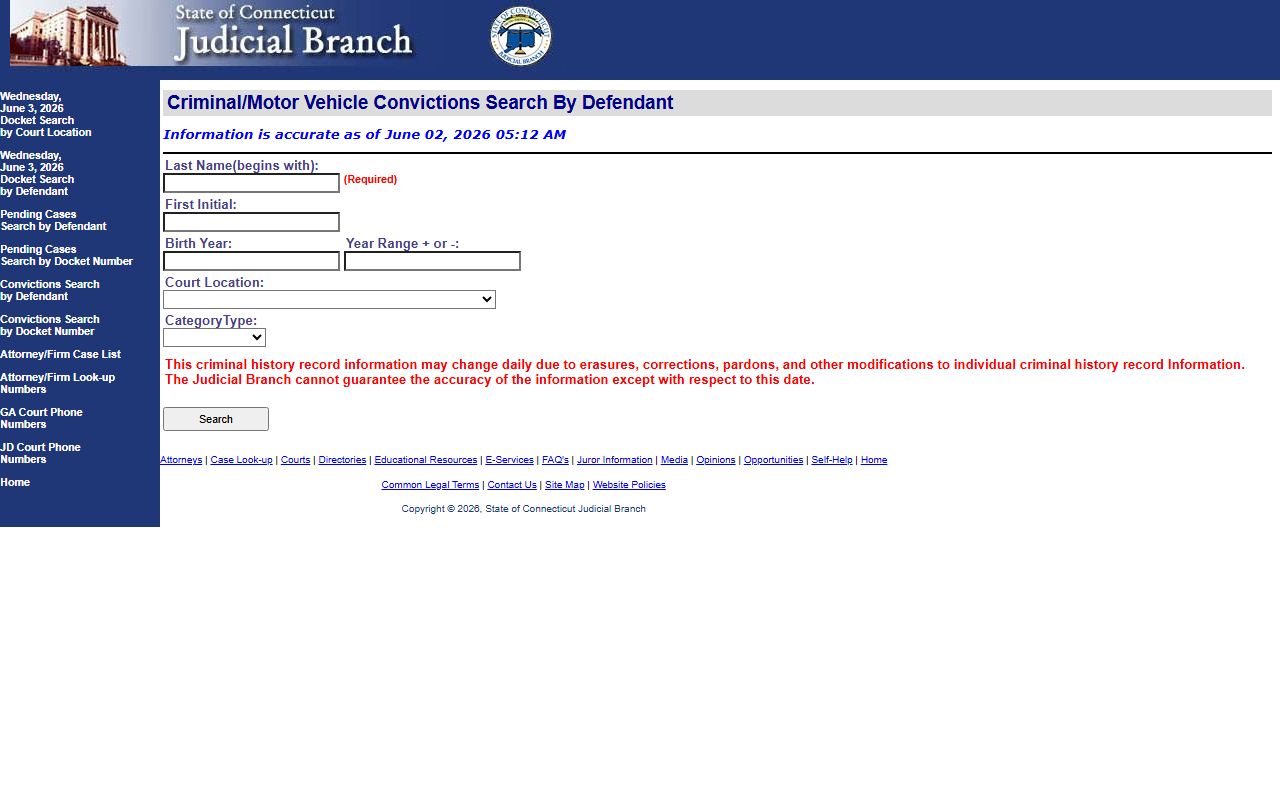
The fields shown match the table above. The last name is required. The Norwalk GA 20 court location sits in the dropdown. Use the tool to confirm a disposition. Then turn to the clerk for certified copies of the full file.
How Norwalk Charges Get Filed: Complaint, Information, and Indictment
After the arrest, the court charge record begins. It opens when the prosecutor files a charging document. In Connecticut state cases the prosecutor usually proceeds by complaint or information. The grand jury indictment is mainly a federal tool. It is not the normal way Connecticut state charges reach a court file. The exact document depends on the class of the offense. It also depends on where the case sits in the process.
- Complaint
- A charging document used by the State's Attorney in many criminal cases; it opens the court file.
- Information
- The prosecutor's formal written charge in most Connecticut state cases, including the felonies handled at GA 20.
- Indictment
- A grand jury charge that is mainly a federal tool and is not the usual route for Connecticut state charges.
The prosecutor controls the charging document. So the charges in the court file can differ from the charges on the arrest log. The State's Attorney may file fewer counts. The office may add a count. It may also swap in a different statute. Reading the charging document is the only sure way to know what the court case really alleges.
Norwalk Charge Status, Nolle, and Disposition
Charges shift as a case moves through Norwalk GA 20. The arrest-log charge can change once the prosecutor acts. It can be amended, reduced, dropped, or replaced. A few status terms appear often in Connecticut court records. Each one means something different for the person and the file. Knowing them keeps you from misreading the record.
| Status | What It Means |
|---|---|
| Pending | The charge is filed but not yet resolved by the court. |
| Amended / Reduced | The prosecutor changed the charge or swapped in a lesser one. |
| Dismissed | The court or prosecutor ended the charge with no conviction. |
| Nolle Prosequi | The State declines to go forward for now; erasure timing can later apply. |
A disposition is the final court result. It can also be the procedural outcome of a charge. Other terms ride alongside these. A violation of probation is an alleged breach of probation terms. It can spin off its own warrant. A failure to appear means a missed court date. That too can trigger an arrest warrant. To pin down the status of any Norwalk charge, search the Judicial Branch by name and birth year. Then call the GA 20 clerk to confirm the live record.
Norwalk Court Records You Must Request in Writing
The online search helps identify a case. The full official file and certified copies route through the clerk. The Judicial Branch court-record FAQ is clear on this. Criminal and motor vehicle record searches should first be made in writing. They go to the geographical area court where the arrest occurred. For a Norwalk arrest, that is GA 20. The request should include the person's name and date of birth. If possible, add the date of arrest or disposition.
The search is limited to records held at that one court. A request for a Norwalk GA 20 file is not a statewide criminal history. Copy charges are set by the Judicial Branch. Court records and documents cost $1.00 per page. Administrative records cost $0.25 per page. Use the police case number, court date, name, and birth date. That helps the clerk find the right file. Details on the written request are on the Judicial Branch court-record FAQ. The criminal "How do I?" hub links the related lookups at jud.ct.gov.
Reading the Norwalk Arrest Log Before the Court File Opens
In the days right after a booking, the Norwalk arrest log is often the fastest source. Norwalk Police build the running arrest, citation, and incident logs automatically at 6 a.m. The arrest log shows a lot. It lists the arrest time, name, address, age, race and sex, and charge and statute. It also lists the arresting officer, court date, bond or fine, and case number. That court date and case number are the bridge into the court system. They link the log to the case once the file opens.
One caution matters most. Log charges are police charges, not court charges. They mark what the officer alleged at the scene. The prosecutor can change all of that. The log also leaves out the booking photo and fingerprints. It skips the full incident report and any witness or victim detail. For more, the Norwalk Police Records Unit handles report and FOI requests. Its internal arrest records update when court dispositions come back, such as Guilty, Nolle, or Dismissed. View the public file on the Norwalk running arrest log.
Note: A name missing from the court search does not prove there was no arrest, since the file may be new, sealed, erased, or filed under a different spelling.
Norwalk Bond, Bail, and Cash Bond Refunds
The Norwalk arrest log carries a bond or fine field. It may show a dollar amount. Connecticut has reshaped low-dollar bond over several years. In 2017, Public Act 17-145 set a goal. It aimed to cut the number and length of pretrial holds for people accused only of misdemeanors. In 2019, court rules added a deposit option. People could put 10% of the bond with the court on any low-dollar bond of $20,000 or less. In 2023, the state lowered that deposit to 7%. It also made the option automatic for bonds up to $50,000.
- Cash bond
- Money posted to secure appearance; refunded by the clerk after disposition or diversion.
- 7% cash deposit
- Automatic court-rule option for eligible bonds up to $50,000.
- Surety bond
- Bond posted through a bail agent for a fee.
- No-bond hold
- Held on another court, probation, federal, or immigration ground despite any bond.
Getting cash bond money back is a clerk task, not a police one. First the case must be disposed, or a diversionary program granted. Then the depositor brings the receipt to the clerk's office. They also bring a state-issued ID or valid driver's license. They go to the court where the case was heard. A check is then issued. Lost the receipt? A lost receipt form can be filled out at the clerk's office. For court status and bond questions, call the Norwalk GA 20 Chief Clerk's Office at (203) 849-3580. Bail Services is at (203) 847-7256.
Norwalk Warrants and Failure to Appear
A warrant is a common reason an arrest happens at all. The Judicial Branch runs a public warrant search. It covers arrest warrants for violation of probation or failure to appear. It also covers orders to incarcerate. You can search by name, town, court location, or any mix of the three. These warrants can lead to a fresh arrest by Norwalk Police. After that arrest, the person can land on the Norwalk arrest log. Then the case moves through GA 20.
| Field | Type | Required | Notes |
|---|---|---|---|
| Last Name | Text | Yes for name search | At least the first two letters. |
| First Name (begins with) | Text | No | Optional prefix search. |
| Town | Dropdown | No | Includes Norwalk, East, South, and West Norwalk. |
| Court Location | Dropdown | No | Includes Norwalk GA 20 and other CT courts. |
| Birth Year | Text | No | Sample format such as 1900. |
| Year Range + or - | Text | No | Optional range. |
The tool has firm limits. It does not contain every warrant type. It leaves out warrants where posting might endanger someone. It also drops youthful offender matters. The Judicial Branch calls the data informational only. It warns users not to act against anyone based on the site. The official search screen appears in the capture of the Judicial Branch warrant search.
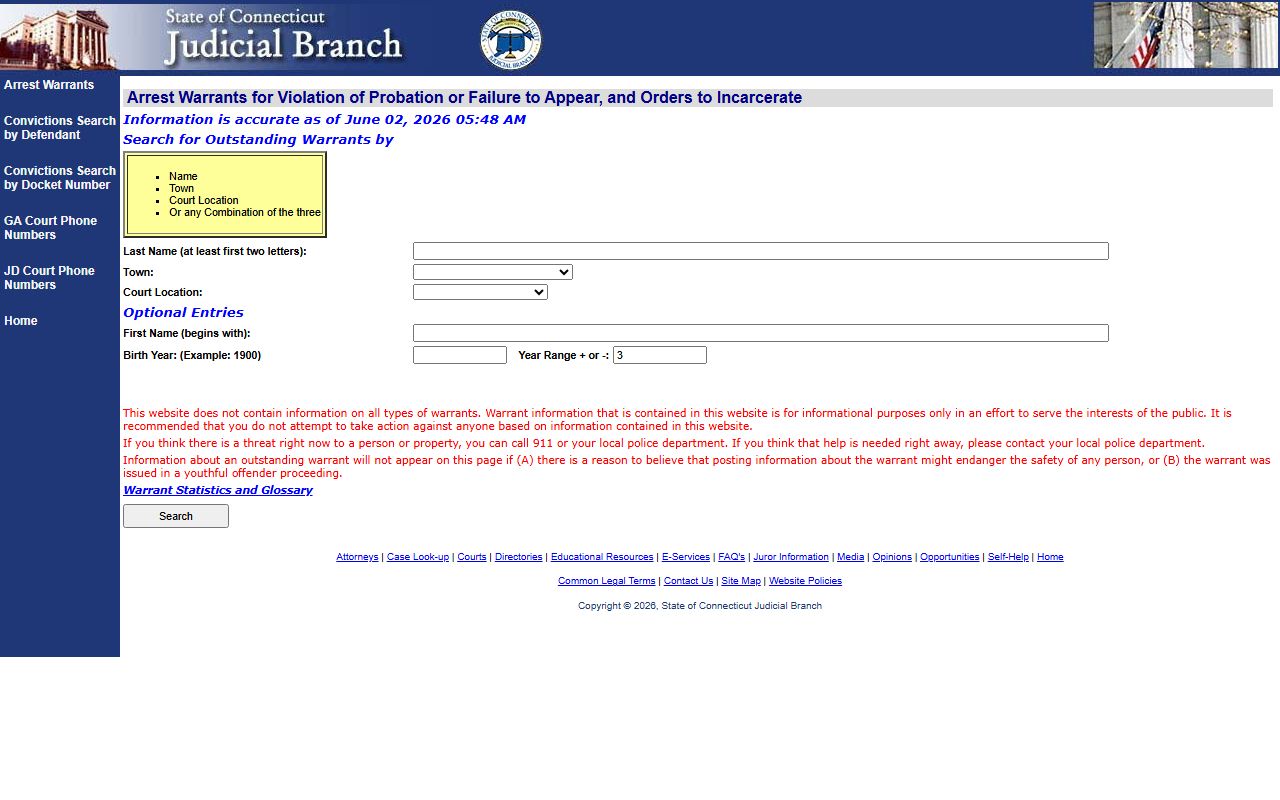
The search misses some warrants. So an empty result is not proof there is no warrant. For a live warrant, call Norwalk Police at (203) 854-3000. You can also call the GA 20 clerk. Use 911 for any emergency.
Charge vs. Conviction in Norwalk Court Records
Being charged is not the same as being convicted. A charge is an accusation. It opens the court record. A conviction is the result. It comes by plea or by verdict. Both can appear in public records. Yet they carry very different weight. Confusing them is the most common reading error after a Norwalk arrest.
- A charge
- Sits at the accusation stage, rests only on probable cause, and is a public record while the case is active.
- A conviction
- Comes from a verdict or a plea, requires proof beyond a reasonable doubt, and is a public record subject to later erasure.
A charge can end many ways short of conviction. It can be dismissed, nolled, or reduced. It can be beaten at trial. None of those is a conviction. In Connecticut several of those outcomes start the clock on erasure. Read the disposition, not just the charge line. Do that before drawing any conclusion about a case.
Sealed vs. Erased Norwalk Court Records
Connecticut does not use the word expungement the way many states do. The state concept is erasure. It lives in the criminal-record statutes. Erasure is broad. Police, court, and prosecutorial records can all be erased. The triggers include a qualifying dismissal, a not-guilty finding, a nolle that ages out, or a pardon. Other statutory criteria can also apply. Sealing is narrower. It simply limits who can view a record while it still exists.
- A sealed record
- Still exists but is hidden from public view. It is sealed by court order or statute while the case stays on file, so it simply drops out of public search.
- An erased record (CGS 54-142a)
- Is treated as if the arrest never occurred. Erasure follows a dismissal, acquittal, aged nolle, or pardon, and removes the entry from police, court, and prosecutor files.
Connecticut also built an automated path. CGS 54-142a sets the core erasure rules. CGS 54-142t goes further. It directs the state to develop an automated erasure process. The Judicial Branch and CJIS help with that work. The statute also calls for published information about eligible records. This is why a Norwalk case that once showed up may vanish from the court search. The statutes sit in Chapter 961a of the General Statutes. Chapter 961a also binds businesses that bulk-collected criminal records. They must update and delete erased entries.
Note: A record erased under Connecticut law should be treated as gone, so neither the public nor commercial sites should keep presenting it as a current case.
Norwalk GA 20 Courthouse Details
Most of these records route to one building. Norwalk Superior Court Geographical Area No. 20 is that court. It holds the case file. It takes the written record request. It issues cash bond refunds too. The contact card below pulls the key numbers from the official directions page. The visitor detail comes from the same source.
Norwalk Superior Court GA 20
17 Belden Avenue
Norwalk, CT 06850
Chief Clerk's Office: (203) 849-3580
Bail Services: (203) 847-7256
Hours: 9:00 a.m. to 5:00 p.m.; doors open 8:30 a.m.
Parking and access are spelled out on the court page. Public parking sits on Belden and Byington Streets. A paid municipal garage stands at 3 Burnell Boulevard. Juror parking is on Byington Street. Handicapped parking is in the courthouse lot by the gate and bell. Wheelchair access is through the front door. Local bus service runs through the Norwalk Transit District. Confirm the address, hours, and directions on the official Norwalk GA 20 courthouse page.
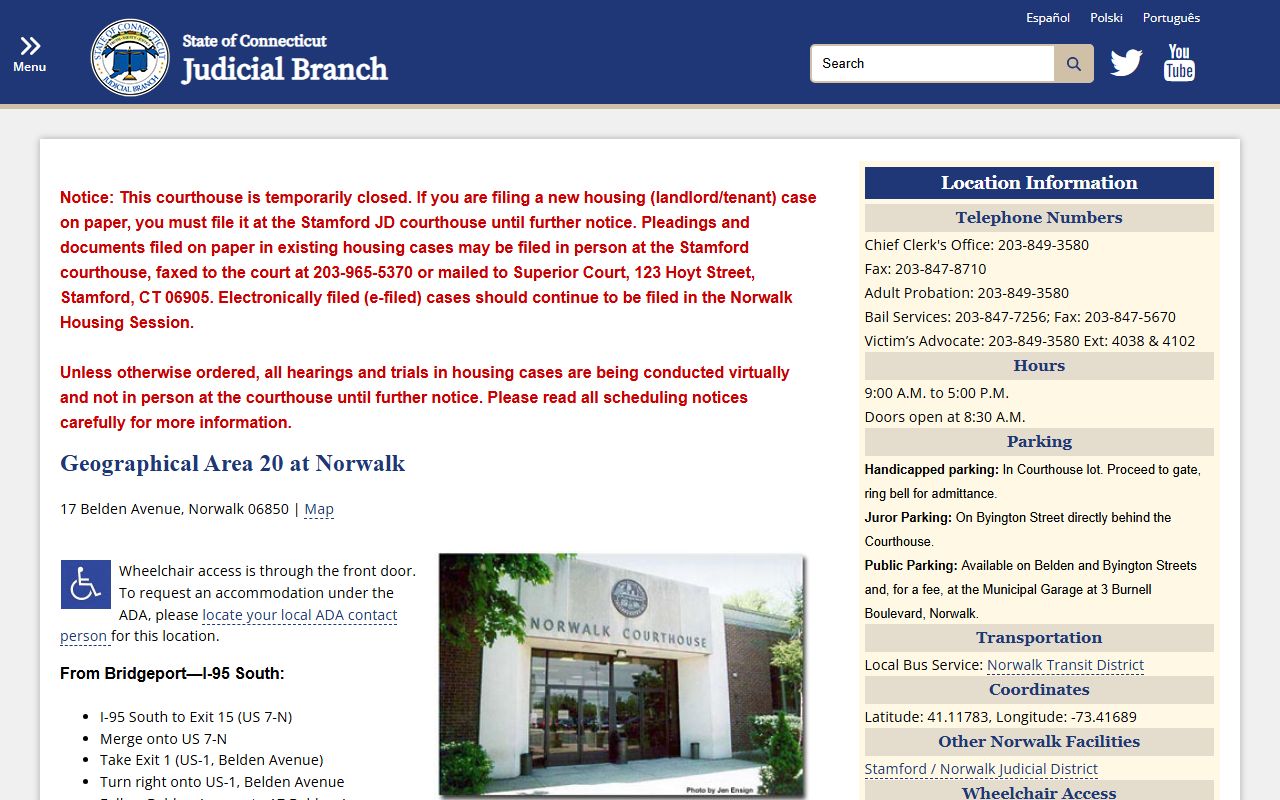
The same page lists more contacts. It carries fax numbers, adult probation, and the Victim's Advocate. So it is the single best stop before a visit. Check it before you read or copy a court file in person.
When a Norwalk Arrest Moves to DOC Custody
Sometimes bond is not posted. Sometimes the court orders a hold. Then the person moves out of local police custody. They go into the Connecticut Department of Correction. The most direct route from a Norwalk arrest is Bridgeport Correctional Center. Its official page says it serves the Norwalk court. At that point two records run in parallel. The court record and the custody record are tracked by different systems.
The court file stays at Norwalk GA 20 and on the Judicial Branch search. Custody and location move elsewhere. They show on the statewide DOC inmate search at ctinmateinfo.state.ct.us. Pretrial and sentenced custody are both held by the same unified state DOC. No county sheriff is involved. Federal and immigration custody are separate again. They are searched through the BOP and ICE locators, not the state system. The full custody walkthrough lives on the jail inmate records page.
Restricted Court Records After an Arrest in Norwalk County
Not every court or arrest record is open. Connecticut FOIA sets the default. Under CGS 1-210, records kept by public agencies are public. A state or federal law can change that. CGS 1-215 governs records that document an arrest or custody. Even so, real limits apply after a Norwalk arrest.
Youthful offender matters are protected. Victim-identifying detail in sexual-assault files is restricted. Reports tied to a pending investigation can be redacted or withheld. Erased cases drop out entirely under the rules above. So an empty search result is never proof that an arrest never happened. Request the specific record from the office that created it. Expect possible redaction. Verify status with the GA 20 clerk or the Norwalk Police Records Unit. Do that before relying on what you find.